Key Highlights |
|---|
| ◉ The Nagchandreshwar Temple opens for public viewing only on Nag Panchami. |
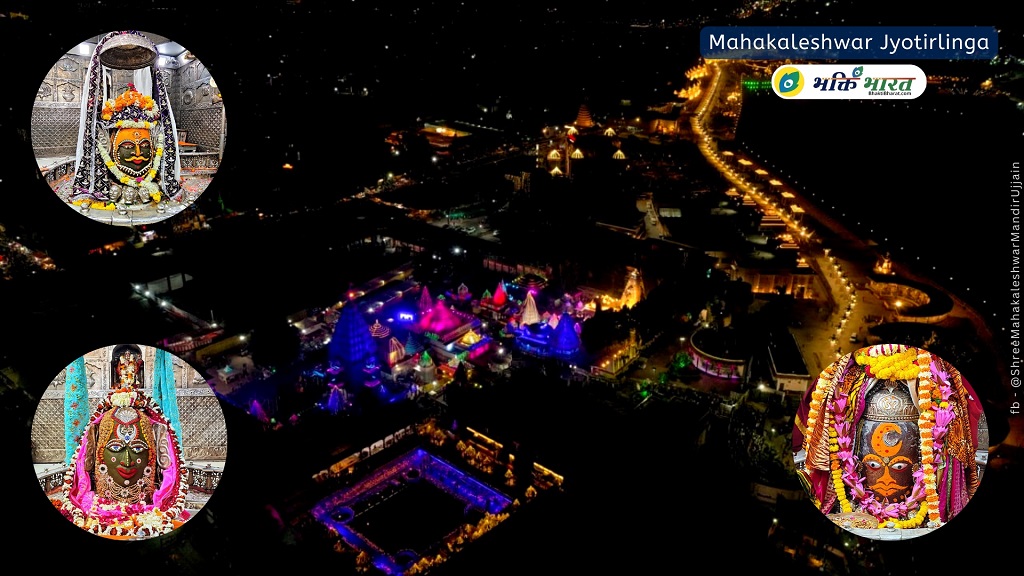
| ◉ The Nagchandreshwar Temple is located on the third floor of the Mahakaleshwar Temple in Ujjain. |
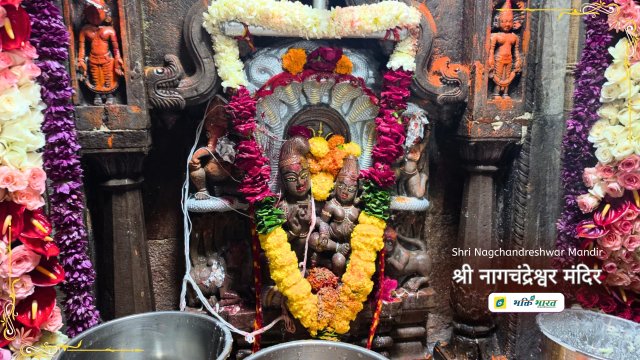
| ◉ In the Nagchandreshwar Temple Shiva and Parvati are traditionally depicted seated on a serpent. |
Nagchandreshwar Temple is a unique temple dedicated to Lord Shiva, situated on the third floor of the Mahakaleshwar Jyotirlinga Temple. This temple opens for devotees only once a year, on the festival of Nag Panchami. On that day, thousands of devotees visit to seek blessings.
Why Temple opened only on Nag Panchami?
The annual opening of the temple has become one of Ujjain's most distinctive religious traditions. Devotees believe that Nag Panchami is the special day when the bond between Lord Shiva and Takshak (the serpent) is honored, offering them the opportunity to seek the blessings of Nagchandreshwar. The temple opens only once a year, on the day of Nag Panchami.
Major Festival of Nagchandreshwar Temple
Nag Panchami is the main festival of the Nagchandreshwar Temple. Since the temple remains closed throughout the year, its annual opening is a major religious event in Ujjain. Traditionally, Shiva and Parvati are depicted seated upon a serpent. This temple holds special significance for devotees seeking relief from *Kaal Sarp Dosh* or fears associated with snakes, as well as for those seeking blessings of prosperity and protection.
How to Reach Nagchandreshwar Temple
The Nagchandreshwar Temple is located on the third floor of the Mahakaleshwar Temple complex and traditionally opens only during Nag Panchami. As there are huge crowds on Nag Panchami, arrangements for accommodation and travel should be made in advance. For pilgrims arriving by train, Ujjain Junction is the most convenient option. The nearest major airport is Devi Ahilya Bai Holkar Airport in Indore.
The main idol in the Nagchandreshwar Temple depicts Lord Shiva and Goddess Parvati seated upon the Serpent King Sheshnag (Ananta). This form of Shiva is considered extremely rare in India. The temple is believed to date back several centuries, and the idol is attributed to the Paramara period (approximately the 11th century).
The history of Nagchandreshwar is deeply intertwined with the ancient religious traditions of Ujjain and the Mahakal Van. According to traditional beliefs, the temple and its unique idol date back to the Paramara era, with some traditions attributing the temple's construction to King Bhoja (circa 11th century). Later, during the Maratha period—specifically in the 18th century—the Mahakaleshwar complex underwent renovation. These dates of construction should be understood as traditional or historical accounts rather than fully established archaeological facts.
The most popular legend is associated with Takshaka, the king of the Nagas. According to traditional lore, Takshaka performed severe penance to please Lord Shiva. Pleased by his devotion, Shiva granted him the boon of immortality. Subsequently, Takshaka sought permission to live in the Lord's presence and lead a life of solitude. Shiva granted his request.
It is believed that Takshaka subsequently became associated with the sacred Mahakal region of Ujjain. Since Takshaka wished to remain undisturbed in his spiritual state, the temple traditionally remains closed throughout the year and is opened only on Nag Panchami. This is cited as the primary religious reason for the temple opening specifically on that day each year.
Another traditional story links Takshaka to the Mahabharata. In Hindu scriptures, Takshaka is described as a powerful king of the Nagas and is associated with the death of King Parikshit. According to later religious traditions, Takshaka performed penance to Lord Shiva, seeking divine protection and forgiveness.
Nag Panchami day 12 AM - 12 PM
 Follow Bhakti Bharat Whatsapp Channel »
** Please write your any type of feedback or suggestion(s) on our contact us page. Whatever you think, (+) or (-) doesn't metter!

कंकाली माता मन्दिर @Sasni, Uttar Pradesh

संतोषी माता मंदिर @Hari Nagar , New Delhi
माँ बाट मंगला मंदिर @Puri, Odisha