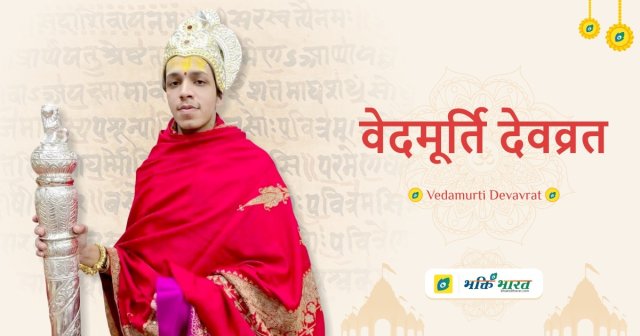
Bhaktamal: Vedamurti Devavrat
Real Name - Vedamurti Devavrat Mahesh Rekhe
Guru - Vedabrahmashri Mahesh Chandrakant Rekhe
Aradhya - Bhagwan Shiv
Place of Birth - Ahilya Nagar, Maharashtra, India.
Marital Status - Unmarried
Father - Vedabrahmashri Mahesh Chandrakant Rekhe
Language - Sanskrit, Hindi, Marathi
Famous - Completed Dandakrama Parayanam - 50 days, ~2,000 mantras without interruption.
Vedamurti Devavrat Mahesh Rekhe is a young Indian Vedic scholar from Ahilya Nagar, Maharashtra, widely recognized for achieving a rare and demanding feat in the traditional Vedic recitation system. He holds the honorific title Vedamurti, conferred for excellence in Vedic studies and recitation.
❀ Trained in traditional Vedic chanting and memory techniques, likely within Guru-Shishya Parampara (teacher-student tradition) under his father and other scholars.
❀ Devavrat Mahesh Rekhe rose to national prominence in 2025 at 19 years old for completing one of the most challenging forms of Vedic chant recitation, called Dandakrama Parayanam. This ritual involves continuous and ultra-precise recitation of nearly 2,000 mantras from the Madhyandina branch of the Shukla Yajurveda over an extended period — in his case, 50 uninterrupted days.
❀ As per bhaktibharat, the Dandakrama Parayanam is highly regarded in the Vedic tradition for its complex phonetic sequence and permutations, difficult mastery of sounds, and mental discipline — a practice that had not been completed in its classical purity for almost 200 years before his accomplishment.
National Recognition & Praise
Prime Minister
Narendra Modi publicly praised Devavrat’s disciplined recitation as the “highest form of our Guru tradition” and said his achievement would be remembered by coming generations.
He was honored in Varanasi (Kashi) — the sacred seat of Vedic learning — and felicitated by spiritual institutions, including blessings from the Jagadguru Shankaracharyas of Sri Sringeri Sharada Peetham.
Legacy & Continuing Mission
Devavrat’s achievement is seen as a revival of an ancient, nearly lost tradition of Vedic recitation and is inspiring renewed interest in classical Sanskrit scholarship and chanting practices among youth and scholars alike.
 Follow Bhakti Bharat Whatsapp Channel »