Shri Krishna Bhajan
Make Bhakti Bharat Your Preferred Source on Google

Why there is no bells in the Banke Bihari temple? (बांके बिहारी मंदिर में घंटियाँ क्यों नहीं हैं?)

Why there is no bells in the Banke Bihari temple?
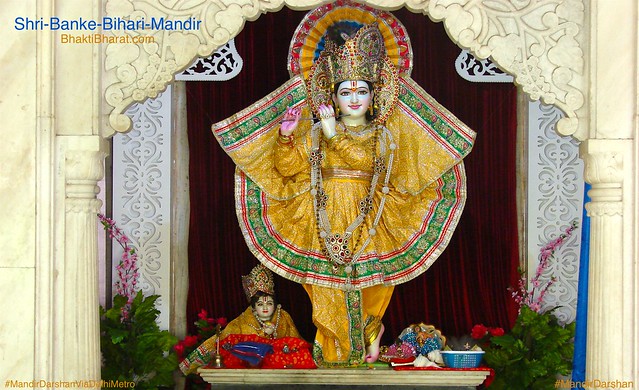
The Banke Bihari Temple in Vrindavan, Uttar Pradesh, is unique in many ways, and one of its most notable features is that there are no bells or gongs in the temple. This is highly unusual for a Hindu temple, where bells are typically rung during aarti (prayer rituals) or while entering the sanctum to awaken or invoke the deity.
The reason behind this:
The absence of bells in the Banke Bihari Mandir is deliberate and symbolic, based on the unique nature of Bhagwan Banke Bihari, who is considered a child-like form of Krishna. Here's why:

1. Krishna as a playful child (Lalita mood):
The deity is worshipped in a very intimate, loving, and personal manner, like one would adore a small child or a beloved. Ringing bells is considered too harsh or startling for this soft, intimate mood of devotion.

2. Unbroken peace and silence:
The philosophy here emphasizes a peaceful, immersive bhakti (devotional) experience. Instead of loud sounds, bhajans (devotional songs) and soft music are preferred, maintaining a calm and loving atmosphere that allows for deep, silent communion with the deity.

3. Letting the Bhagwan rest:
It is believed that Banke Bihari ji should not be disturbed, even by the sound of bells. The Lord is treated as a child who should not be awakened suddenly or startled by loud noises. This is why even the aarti is performed only once a day, unlike other temples where it happens multiple times.

4. Historical and spiritual tradition:
This tradition was established by Swami Haridas, the great saint and spiritual master of Tansen (from Akbar's court), who installed the deity. His devotional path emphasized sweetness (madhurya bhav) and serenity over ritualistic grandeur.

In summary, the absence of bells at the Banke Bihari Temple reflects a deeply devotional, tender relationship between the devotee and Lord Krishna, rooted in love, intimacy, and gentleness, rather than formality or ritual noise.
बांके बिहारी मंदिर में घंटियाँ क्यों नहीं हैं? हिन्दी में पढ़ें

उत्तर प्रदेश के वृंदावन में स्थित बांके बिहारी मंदिर कई मायनों में अनोखा है, और इसकी सबसे उल्लेखनीय विशेषताओं में से एक यह है कि मंदिर में घंटियाँ नहीं हैं।
Read Also

There is no bell in the sanctum sanctorum of Puri Jagannath Dham either. It is said that Lord Jagannath always waits for his devotees, so ringing the bell does not alert him.

Blogs Banke Bihari Temples BlogsBrij Holi Clender BlogsBarsana Holi Date BlogsMathura Holi Dates BlogsVrindavan Holi Calendar BlogsHoli BlogsHolika Dahan BlogsDulahandi BlogsDuj BlogsHolika BlogsFestival Of Colors BlogsBanke Bihari Mandir BlogsVasant Panchami BlogsBarsana BlogsMathura BlogsVrindavan BlogsNandgaon Blogs

If you love this blogs please like, share or comment!

Whatsapp ChannelFollow Bhakti Bharat Whatsapp Channel »

Bookmark / Save this blogs for future Add To Favorites
* Please share any of your suggestions or ideas with us.

** Please write your any type of feedback or suggestion(s) on our contact us page. Whatever you think, (+) or (-) doesn't metter!

Latest Blogs ›

Why Non-Hindus Cannot Enter the Jagannath Temple

The ban on the entry of non-Hindus into the Jagannath Temple in Puri is one of the most widely discussed aspects of the temple. Although this rule may seem unusual to some, it is rooted in centuries-old religious traditions and temple customs rather than modern laws.

Tahiya the crown of Bhagwan Jagannath in Rathyatra

During Rath Yatra, Bhagwan wears Tahiya during Pahandi Bije. Tahiya is the only ornament worn by the Bhagwan during the Rath Yatra rituals.

Why is Jagannath Temple Prasad called Mahaprasad?

The Mahaprasad, which has been found in the Jagannath temple for centuries, is made by around 600-700 cooks, which is distributed among about 50 thousand devotees.

What is the story behind Bhagwan Jagannath being in the form of Neela Madhav?

The story of Lord Jagannath as Neela Madhava (or Nila Madhava) is a deeply spiritual and symbolic story rooted in ancient Hindu traditions, especially those of Odisha.

How to offer Belpatra on Shivling?

When offering Belpatra (Bilva Patra) on Shivling, according to Hindu scriptures and traditional worship practices, it should be offered in a specific way.

Puri Jagannath Gundichha Rani and the Nakachana Katha

There are two gates in front of the Srigundicha temple wall. One is 'Singhadwar' and the other is 'Nakachana Dwar'. On the day of 'Srigundichayatra', three chariots go from the Singhadwar of the temple and proceed to the Singhadwar of Gundicha temple.

Difference between Sankasthi Chaturthi and Vinayak Chaturthi?

According to the law of scriptures, the Chaturthi of Shukla Paksha which comes after the new moon is called Vinayak Chaturthi and the Chaturthi of Krishna Paksha which comes after the full moon is called Sankashti Chaturthi.

Hanuman Chalisa - Hanuman Chalisa
Bhakti Bharat APP

