Shri Krishna Bhajan
Make Bhakti Bharat Your Preferred Source on Google

The Mythological Story Behind Baglamukhi Jayanti (बगलामुखी जयंती के पीछे पौराणिक कहानी)

The Mythological Story Behind Baglamukhi Jayanti
Baglamukhi Jayanti is believed to be the day when the Devi Baglamukhi appeared on earth. It is celebrated on Shukla Ashtami or the eighth day in the month of Vaishakh. Bagalamukhi Jayanti will be celebrated on Monday, 9 May 2022. Mata is the incarnation of Shakti and is one of the ten Mahavidya.
Baglamukhi Mantra
“ॐ ह्रीं बगलामुखी सर्वदुष्टानांवाचं मुखं पदं स्तंभय जिह्वां कीलयबुद्धि विनाशय ह्रीं ॐ स्वाहा।”

Pauranik Katha
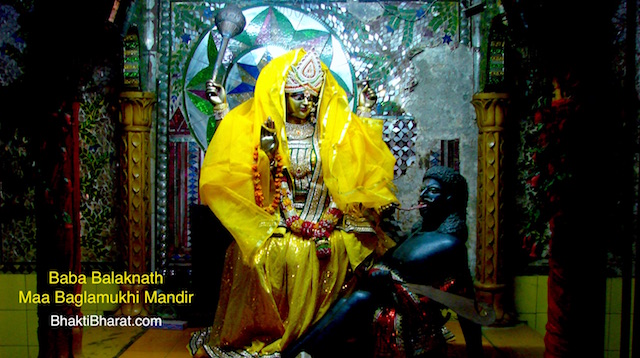
The Devi is believed to have appeared to protect the religion which was challenged by an asura named Madan. Devi defeated him and pulled out his tongue. The demon then prayed for forgiveness.

Symbolically, this suggests that the greatest threat to religion is from unwanted speech.

There are many legends associated with the Devi Bagalamukhi and most of them are popular in the western parts of India. A popular legend says that the Devi Shakti took the form of a Bagalamukhi to protect the universe from a huge storm that had the potential to destroy the universe.

Shakti temples have special rituals on this day.

Some important facts about Baglamukhi
Devi Baglamukhi is also known as Pitambari Devi.
The most important temple dedicated to Bagalamukhi (Pitambara Peeth) is located in Datia, Madhya Pradesh.

बगलामुखी जयंती के पीछे पौराणिक कहानी हिन्दी में पढ़ें

माना जाता है कि बगलामुखी जयंती वह दिन है जब देवी बगलामुखी धरती पर प्रकट हुई थीं। यह वैशाख माह में शुक्ल अष्टमी या आठवें दिन मनाया जाता है। बगलामुखी जयंती सोमवार, 9 मई 2022
Read Also

Blogs Baglamukhi BlogsMaa Baglamukhi BlogsBaglamukhi Jayanti BlogsPitambara Blogs

If you love this blogs please like, share or comment!

Whatsapp ChannelFollow Bhakti Bharat Whatsapp Channel »
Bookmark / Save this blogs for future Add To Favorites
* Please share any of your suggestions or ideas with us.

** Please write your any type of feedback or suggestion(s) on our contact us page. Whatever you think, (+) or (-) doesn't metter!
Latest Blogs ›

What is the meaning of Dandi Sanyasi?

Danda means stick or cane in Sanskrit and the Sanyasi who keeps this stick is called Dandi Sanyasi. The Dandi Sanyasis, an important sect of saints in the country, claim that Shankaracharya was chosen from among them.

Solapuja at Vimala Peeth Puri

The Vimala Temple (also written as Bimala or Vimala Peeth) is a very sacred Shakti Peeth located inside the Jagannath Temple complex, Puri (Odisha).

What is Gandamool?

Gandamool (also spelled Gandmool or Gandanta Nakshatra) is an important concept in Vedic astrology referring to certain birth constellations (nakshatras) that are believed to create difficulties or karmic challenges in a person’s life if they are not properly appeased through rituals.

Indian Ritus/Seasons

Talking about all the seasons, there are a total of six seasons in a year. In this case, the duration of each season is two months.

Abhijit Muhurat

Abhijit Muhurat is an auspicious time in the afternoon that lasts for about 48 minutes. Abhijit Muhurat can destroy innumerable doshas and is considered as one of the best Muhurats to initiate all kinds of auspicious works.

What is (Krishna and Shukla) Paksha?

Monthly Panchang i.e. a month in the Hindu calendar is divided into 30 days. These 30 days is divided into two sides. In which one Paksha of 15 days is called Shukla Paksha and the remaining 15 days is called Krishna Paksha. The more and lesser phases of the Moon are called Shukla and Krishna Paksha.

Truth of Hindu Sanatan Dharm

Hinduism or Sanatan Dharm is made up of diverse traditions and cannot be traced to a single founder.

Ram Bhajan - Ram Bhajan
Bhakti Bharat APP