Haanuman Bhajan
Make Bhakti Bharat Your Preferred Source on Google

Why Non-Hindus Cannot Enter the Jagannath Temple (जगन्नाथ मंदिर में गैर-हिंदुओं का प्रवेश क्यों वर्जित है?)

Why Non-Hindus Cannot Enter the Jagannath Temple
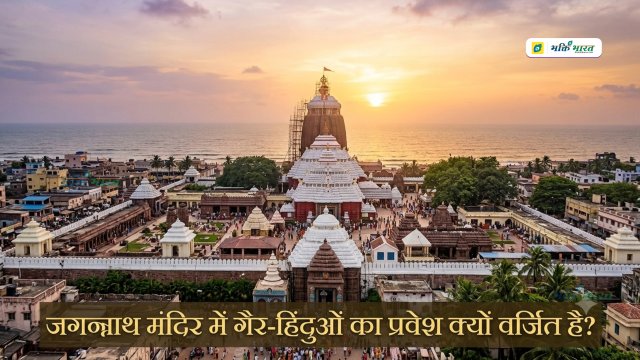
The ban on the entry of non-Hindus into the Jagannath Temple in Puri is one of the most widely discussed aspects of the temple. Although this rule may seem unusual to some, it is rooted in centuries-old religious traditions and temple customs rather than modern laws. Understanding its historical and spiritual context sheds light on why this tradition continues to this day.
Traditional Entry Policy of the Temple
The Jagannath Temple follows a long-standing tradition under which only Hindus are permitted to enter the temple premises. In addition to Hindus, followers of religions that originated in India—such as certain Buddhists, Jains, and Sikhs who are connected to Indian religious traditions—may also be granted entry, subject to the temple administration's interpretation and traditional customs.

Foreign nationals and individuals who do not identify as Hindu are generally not permitted to enter the temple, regardless of their personal beliefs or faith.

Why is entry restricted?
1. Preservation of ancient temple traditions
Puri Jagannath Temple has adhered to its religious customs for centuries. The temple administration and the hereditary servitors (*sevayats*) believe that preserving these traditions is essential to maintaining the temple's sanctity and ensuring that rituals are performed without interruption.

2. Ritual Purity
In accordance with the temple's Agamic and traditional practices, there are specific rules regarding ritual purity for worship. These customs determine who may enter certain sacred areas and who may participate in rituals. These restrictions are based on religious practices rather than nationality or ethnicity.

3. Historical Reasons
Historians state that due to repeated invasions and attempts to desecrate temples in medieval India, many temples adopted stringent measures to safeguard their deities, rituals, and sacred spaces. Over time, these practices became an integral part of temple tradition.

4. Respect for Religious Autonomy
In India, many places of worship have the right to manage their religious affairs in accordance with established customs, while remaining within the framework of applicable laws. The Jagannath Temple administration states that its entry policy is an integral part of its religious tradition.

Many ancient temples in India restrict entry based on their traditions. Some examples include:
Guruvayur Temple
Padmanabhaswamy Temple
Kashi Vishwanath Temple (specific rules apply to the sanctum sanctorum)
Lingaraj Temple

Although entry into the temple is restricted, Lord Jagannath is widely regarded as a universal deity. During the annual Rath Yatra, the deity emerges from the temple to mingle with the people. This symbolizes that divine grace is bestowed upon everyone without discrimination. The festival embodies Jagannath's attribute as 'Patitapavana'—the redeemer of all.
जगन्नाथ मंदिर में गैर-हिंदुओं का प्रवेश क्यों वर्जित है? हिन्दी में पढ़ें

पुरी के जगन्नाथ मंदिर में गैर-हिंदुओं के प्रवेश पर लगी रोक मंदिर से जुड़ी सबसे चर्चित बातों में से एक है। हालांकि यह नियम कुछ लोगों को अजीब लग सकता है, लेकिन यह आधुनिक कानून के बजाय सदियों पुरानी धार्मिक परंपराओं और मंदिर की रीति-रिवाजों पर आधारित है।
Read Also

Blogs Gundichha Rani BlogsNon-Hindus BlogsPuri Jagannath Rath Yatra BlogsDaru Bramha BlogsRath Yatra BlogsGundicha Yatra BlogsJagannath Rath BlogsChariot Festival BlogsRath Yatra Dates BlogsNetrautsav BlogsNetotsav BlogsHera Panchami BlogsSuna Besh BlogsNiladri Bije BlogsNakachana Katha Blogs

If you love this blogs please like, share or comment!

Whatsapp ChannelFollow Bhakti Bharat Whatsapp Channel »

Bookmark / Save this blogs for future Add To Favorites
* Please share any of your suggestions or ideas with us.

** Please write your any type of feedback or suggestion(s) on our contact us page. Whatever you think, (+) or (-) doesn't metter!

Latest Blogs ›

Why Non-Hindus Cannot Enter the Jagannath Temple

The ban on the entry of non-Hindus into the Jagannath Temple in Puri is one of the most widely discussed aspects of the temple. Although this rule may seem unusual to some, it is rooted in centuries-old religious traditions and temple customs rather than modern laws.

Tahiya the crown of Bhagwan Jagannath in Rathyatra

During Rath Yatra, Bhagwan wears Tahiya during Pahandi Bije. Tahiya is the only ornament worn by the Bhagwan during the Rath Yatra rituals.

Why is Jagannath Temple Prasad called Mahaprasad?

The Mahaprasad, which has been found in the Jagannath temple for centuries, is made by around 600-700 cooks, which is distributed among about 50 thousand devotees.

What is the story behind Bhagwan Jagannath being in the form of Neela Madhav?

The story of Lord Jagannath as Neela Madhava (or Nila Madhava) is a deeply spiritual and symbolic story rooted in ancient Hindu traditions, especially those of Odisha.

How to offer Belpatra on Shivling?

When offering Belpatra (Bilva Patra) on Shivling, according to Hindu scriptures and traditional worship practices, it should be offered in a specific way.

Puri Jagannath Gundichha Rani and the Nakachana Katha

There are two gates in front of the Srigundicha temple wall. One is 'Singhadwar' and the other is 'Nakachana Dwar'. On the day of 'Srigundichayatra', three chariots go from the Singhadwar of the temple and proceed to the Singhadwar of Gundicha temple.

Difference between Sankasthi Chaturthi and Vinayak Chaturthi?

According to the law of scriptures, the Chaturthi of Shukla Paksha which comes after the new moon is called Vinayak Chaturthi and the Chaturthi of Krishna Paksha which comes after the full moon is called Sankashti Chaturthi.

Hanuman Chalisa - Hanuman Chalisa
Bhakti Bharat APP